

Subscription bombing: How inbox chaos creates an opening for the real attack
Subscription bombing can flood an inbox with thousands of legitimate emails, creating confusion and cover for a second-stage attack. Here’s how attackers use the noise to set up social engineering and why looking at activity across communication channels matters.
Key takeaways
Subscription bombing floods an inbox with legitimate emails that pass authentication checks and contain no malicious payload.
The flood is often a setup: It creates a real problem that makes a follow-up impersonation of IT support more credible.
The attack can move from email to collaboration platforms such as Microsoft Teams, so each event can look like a separate issue when viewed alone.
Security teams need context across channels to recognize that the email flood and the IT impersonation are part of the same attack.
It starts with an inbox that suddenly becomes impossible to manage. An employee who was receiving a normal stream of email suddenly gets newsletter confirmations, account registrations, and subscription notices that just keep coming.
Then a message arrives in Microsoft Teams from someone claiming to be from the IT Helpdesk. They know about the email problem and offer to help fix it. And because the employee can see that something really is wrong, the outreach seems credible.
That timing is exactly the point. The attacker has created a problem and can now take advantage of the confusion by showing up as the person offering to solve it. That’s what makes subscription bombing more than an inbox problem. It is a setup for the attack that follows.
When legitimate email becomes part of the attack
Subscription bombing works differently from familiar phishing attacks. Instead of relying on a single malicious email, attackers submit a user’s email address to large numbers of legitimate signup forms. The resulting messages can come from legitimate senders, pass email authentication checks, and contain no malicious payload. Individually, those emails may be harmless, but collectively they create noise and disruption.
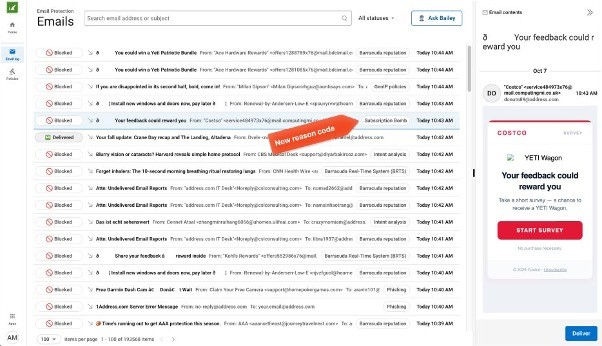
The volume can make legitimate messages harder to find and create an urgent problem for the employee. It can also potentially bury important financial or security notifications. That disruption is what makes the technique valuable to an attacker. Rather than asking an employee to trust a completely fabricated story, the attacker can exploit a real situation unfolding in front of them.
From email flood to cross-channel attack
Attackers don’t have to stay in the channel where an attack begins. A subscription bomb may start in email, while the next stage moves to a collaboration platform such as Microsoft Teams. An attacker can impersonate IT support after the flood begins, taking advantage of the fact that the employee already has a legitimate reason to believe something is wrong.
Viewed independently, these events can look like separate security problems:
- An inbox is being flooded with subscription emails.
- Someone claiming to be IT is contacting an employee.
Together, they can reveal something more significant: An attacker may have deliberately created an email crisis and is now attempting to exploit it through social engineering.
That’s why context matters. Security teams need to consider what happens around the attack and what activity follows, instead of treating the subscription bomb as the entire incident.
How Barracuda helps connect the attack
Stopping a subscription bomb is important, but the larger challenge is recognizing when the email flood is part of a broader attack.
Barracuda Email Protection helps detect subscription bombing at the email layer by identifying unusual increases in message volume and distinguishing subscription and confirmation emails from legitimate mail. This allows legitimate email to continue flowing while addressing the messages associated with the flood.
But the attack may not stop at the inbox. Barracuda Managed XDR can identify fake IT support activity in Microsoft Teams, helping security teams recognize when an attacker may be using the disruption created by the subscription bomb to support a social-engineering attempt.
Together, these capabilities help security teams see more than two isolated events. They provide context around an attack that begins with inbox disruption and then moves into IT impersonation through another communication channel.
That broader view can help defenders focus not only on stopping the immediate flood, but also on understanding what the attacker may be trying to accomplish next.
Look beyond the noise
Subscription bombing is difficult to ignore. When an inbox suddenly fills with hundreds or thousands of unwanted messages, stopping the flood naturally becomes the immediate priority. But the most visible part of an attack isn’t always the most important.
Security teams should also consider what the disruption might be intended to accomplish. Is the attacker simply generating noise, or is that noise creating an opportunity for something else? That broader perspective matters as social-engineering attacks move between email and collaboration channels. An event that seems isolated in one system can take on very different meaning when viewed alongside activity occurring somewhere else.
Because sometimes the inbox chaos isn’t the attacker’s objective. It’s what creates the opening.







O que os Clientes MSP precisam a seguir, da retaguarda à sala do conselho de administração
A Barracuda Research constatou que a excelência técnica continua a ser essencial, mas o crescimento futuro será impulsionado pela especialização em AI, pela resiliência cibernética e pela capacidade de comunicar o risco em termos empresariais.
Subscreva o Blogue Barracuda.
Inscreva-se para receber destaques sobre ameaças, comentários do setor e muito mais.

Relatório sobre a lacuna de competências em cibersegurança: o risco da IA lidera a lista
O inquérito da Barracuda Research a 2000 responsáveis de segurança conclui que 94% referem lacunas de competências em cibersegurança, ao mesmo tempo que a IA reduz as funções de segurança de nível inicial que ajudam a formar futuros investigadores.